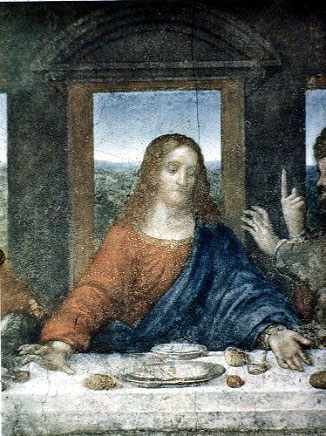
The Last Supper by Leonardo Da Vinci
Church experiences
A place to post inpirations, experiences, ideas and sermons about Church and CSS.
Tuesday, July 12, 2005

This is the banner for The Threshold of Hope, a new blog started by me, Nic Teo and Chris Ow. All my new thoughts about the church and such are posted on this new blog. Please visit at thresholdofhope.blogspot.com
Thursday, January 06, 2005
Media Relations
Don't you think that Archbishop's comments on the tsunami published today in the Straits Times looked totally inadequate beside the comments of the pastor from City Harvest Church? This is not the first time that I am getting this impression. I seriously think that the Archibishop's office and the Church needs to have a media relations person. Very dissapointing, Archie...
Straits Times: Jan 5, 2005
A little light to heal a darkened world
As the world sympathises with victims of the tsunami, Life! asks religious leaders here how faith can heal sorrow
By Jill Alphonso and Sujin Thomas
MOHAMED KHAIR RAHMAT, 35, Imam of Al-Falah Mosque at Bideford Road
'What happened is awful, especially considering that so many of those who died were women and children. The congregation at the Al-Falah mosque was naturally shocked by the disaster.
However, Muslims believe that this world is a place to be tested, and that all trials come from God. As a result, we do not blame God.
We believe that we have been created for a purpose - to do good in this world. With each trial, we should reflect on whether we have done good deeds in our lives and whether we have essentially been good people.
We also believe that those who have died were fated to. The Prophet also says that those who die traumatically - through accidents, burns or drowning - will have a place with Allah because their suffering is great.
It is our responsibility to help the surviving victims through prayer. In our sermons, we try to deepen the congregation's empathy and compassion for the victims.
We encourage them to do what they can, be it through prayer or through giving to charity.
The principles in Islam lead us to believe that there is something to be learnt from every situation, no matter how awful it may be. We believe that there is always a blessing to be found.
For example, we can see that the world's commitment is now to help the victims, with so many nations rallying to give aid. We can take some comfort there.
At the end of the day, we try not to dwell on the tragedy itself, but to see what we can do.'
REVEREND KONG HEE, 40, senior pastor and founder ofthe City Harvest Church in Jurong
'The Christian community is very much saddened by the earthquake and tsunami disaster. For the Christians, we accept that we live in an imperfect world. Bad things do happen to good people.
In light of the disaster, this is a time for great spiritual introspection. Our faith teaches us to always put our trust in God, and even when we can't see his hands, we can always trust his heart.
The Christian faith makes it clear that in this world, there will be trials and tribulation. God did not promise life without struggle. The Bible teaches that suffering, disasters and all order of human difficulties are unavoidable.
We believe that every hardship can be overcome. God promises us provision in need, strength for the day, healing and comfort in our darkest hour.
If we go through the disaster with our faith intact, we will become better people at the end of the day.'
REVEREND MONSIGNOR NICHOLAS CHIA, 66, Archbishop of Singapore
'We are saddened by the calamity and are relying on our faith to get us through. We are encouraging people to be compassionate, and to donate and pray for the victims.
Mass prayer sessions, for example, will be held at most Roman Catholic churches next Friday.
We try not to dwell on the tragedy itself, but concentrate on aid and prayer. As Jesus is merciful, we believe that we ourselves should follow in that vein.'
THE VENERABLE SHI MING YI, 42, abbot of the Foo Hai Ch'an Monastery at Geylang East and chief executive of Ren Ci Hospital
'The tsunami disaster is something totally unexpected. Such a disaster serves to wake people up to realise that life is impermanent and unexpected.
In the Buddhist faith, we believe in karma. Karma is basically explained in the sense where when you do good, you receive good fruits for your deeds. Likewise, when you do bad deeds, you receive punishment. Bad karma can also be due to what people have done in their past lives.
However, in this instance, I am not indicating that the people who died had bad karma. Rather, we should look at it as the collective karma of the world. To have a better future, we should all do good together.
It really takes time to get over losing somebody close to you or even seeing such a tragedy of a major scale. From a religious point of view, we can say prayers for the victims as they move on to another life.
The main concern for the living is to treasure your relatives, friends and loved ones. Do not wait for the moment to come before doing good deeds such as charity work or expressing your love to your loved ones.
The tragedy has already happened. What we can do is to transfer some merits to the departed ones by doing things that benefit the people affected as a whole.'
RABBI MORDECHAI ABERGEL, 36, spiritual leader of the Singapore Jewish community
'Our first reaction should be: 'Where can I help or contribute?' When people witness a tragedy of such proportions, their faith is affected.
We should not let the sadness affect us to the point that we lose our focus on the main issue at hand and that is to extend our assistance. Even a letter written by a small child can go a long way to bring comfort to the bereaved.
In these moments of sadness when we are most vulnerable, we must strengthen our resolve to reach out and help, one act of kindness at a time.
In our Bible there is a saying: 'A little light dispels a lot of darkness.' We can change the world one small deed at a time. Now, more than ever, we must realise we are worth what we are ultimately willing to share and give.'
MRS RANJANA NANIKRAM, 54, secretary of the Sandhu Vaswani Centre
'Hindus believe there is this life and after that there is rebirth. There is what we call 'prakriti', which is like 'nature'. Nature takes its own course and has its own place in the universe, which is always balancing itself.
Hindus believe that they are made up of more than one body in the sense of it being composed of physical, subtle and universal bodies.
If we did not have spirituality within us, there would be no life. If you see a dead body, it is just a physical body. What is missing? It is the spirituality.
It is very difficult for people stricken by the disaster. You must remember not to lose your faith. Let it be your anchor. These people who are helping the affected people in Asia are instruments of God because they are inspired by goodness. Goodness can come only from God.
I think it will take a long time for people to get over the disaster. It is not only a physical wound, but also an emotional one that has to heal.
On top of that, the fear will always be there because the waves came when they never expected them and could come again in future.'
Sunday, December 26, 2004
Prayer before starting work
My Heavenly Father,
as I enter this workplace, I bring your presence with me.
I speak Your peace, Your grace, Your mercy,
and Your perfect order into this office.
I acknowledge Your power over all that will be
spoken, thought, decided, and done within these walls.
Lord, I thank You for the gifts You have blessed me with.
I commit to using them responsibly in Your honour.
Give me a fresh supply of strength to do my job.
Anoint my projects, ideas, and energy,
so that even my smallest accomplishment may bring You glory.
Lord, when I am confused, guide me.
When I am weary, energize me.
When I am burned out,
Infuse me with the light of the Holy Spirit.
May the work that I do and the way I do it bring
faith, joy, and a smile to all that I come in contact with today.
And oh Lord, when I leave this place, give me travelling mercy.
Bless my family and home to be in order as I left it.
Lord, I thank you for everything You've done,
everything You're doing, and everything You're going to do.
In the name of Jesus I pray, with much love and Thanksgiving...
Amen.
Please share this with other Christians that are in the work force, and be a blessing by passing it on to those who may need to be encouraged. Never think that God's delays are God's denials. Hold on; hold fast; hold out. Patience is genius. Have a blessed day
An old Irish prayer
May the road jump up to greet you
and may the wind alway be at your back,
may the sun shine beautifully on your face.
May the rain fall light upon your fields
and until we meet again
may God hold you in the palm of His hand.
Monday, December 20, 2004
Matthew 1:21 :
"She will bear a son and you are to name him Jesus, because he will save his people from their sins."
"Emmanuel" means "God-with-us". Anyone knows what the name "Jesus" means?
Friday, December 03, 2004
Young Catholics
Commonweal
November 19, 2004 / Volume CXXXI, Number 20
ARTICLE
Young Catholics
When labels don’t fit
Cathleen Kaveny
In her book The New Faithful, Colleen Carroll asserts that young Catholics take a more conservative approach to matters of faith than their elders do. According to James Davidson and Dean Hoge, that assertion is not supported by the empirical data produced in their study and earlier studies they have conducted.
One could respond to this apparent contradiction by picking a “side” and sticking to it. So-called conservative Catholics might continue to cite Carroll, while so-called Catholic liberals might point to the Davidson/Hoge data. That response would be a shame, because it would forfeit a valuable opportunity to discuss the challenges involved in handing on the faith to the next generation.
Davidson and Hoge say that “millennial” Catholics (born between 1978 and 1985) are not markedly different from the post-Vatican II generation (born between 1961 and 1977). That leaves open the question of how different the attitudes of those who grew up after the Second Vatican Council are from those who grew up before or during it. In my view, that is the crucial dividing line. I am a post-Vatican II Catholic; my students are millennial Catholics; although different in some important ways, our respective experiences of growing up in the church have more in common with each other than either does with the experience of those whose faith formation took place in the pre-Vatican II church.
I see six basic differences between younger Catholics and earlier age cohorts. First, we learned early and well that we were children of the triune God, who loved us very much, and who was truly present to us in the sacraments. The specter of a vengeful, legalistic divine judge does not haunt us the way it seems to haunt some older Catholics. Second, we really didn’t learn much doctrine. The emphasis in our catechesis was on engaging our emotions, not on challenging our intellects. Third, the coherent Catholic culture of the pre-Vatican II church had broken up by the time we came along. We do not have the Catholic-in-our-bones sensibility that characterizes both liberals and conservatives of earlier generations. Fourth, the end of the Catholic ghetto means that most young Catholics do not feel a need to prove themselves to the outside world. Fifth, our earliest experiences of the church were marked by tumult and controversy, not by stability. The church itself seems much more fragile to us than it does to our elders. Sixth, and finally, the tensions between magisterial teaching and American culture have only grown with time. Consequently, negotiating one’s dual identities as a young Catholic and a young American has also become more difficult.
What does all of this have to do with the use of the labels “liberal” and “conservative”? First, it puts them in their appropriate context. For example, older conservatives should not necessarily delight, and older liberals should not necessarily despair, if some Catholics in college or graduate school thirst for knowledge of the tradition, or enthusiastically pursue new uses for aspects of the tradition that were discarded in the wake of the Second Vatican Council. Given their situation, it is understandable that young Catholics will seek to acquire the basic knowledge, even the basic lore, that their grandparents take for granted. Speaking from experience, it is deeply unsettling to find oneself unable to participate in the common prayers said at the wake of a beloved relative, simply because no one had thought it important to pass them on to the next generation. But such a thirst for knowledge about the tradition, for a tangible connection with one’s communal past, does not necessarily mean that one is opposed ab initio to arguments made for its development, particularly if they are made in terms of values and virtues internal to the tradition itself. To put it bluntly, one can appreciate the value of the Latin Mass, devotions to the saints, and the penitential practice of fasting, even while viewing, with sympathy and admiration, John Noonan’s arguments for the development of Catholic moral doctrine on both contraception and the death penalty.
Second, their study suggests that we look beneath the ideological stances that divide a particular generation to find the common experiences that unite it. In teaching millennials at Notre Dame, for example, I have encountered many young students fitting Colleen Carroll’s “new conservative” profile, and also many students who seem to be more open to the currents in contemporary culture. Despite their superficial differences, a certain subgroup of each category bears a worrisome resemblance to each other on certain points. At the risk of gross generalization, if not oversimplification, I will attempt to flesh out my worries.
Let me call one segment of the more liberal group the compartmentalizers. For them, the various segments of their life are neatly divided. “Faith” is relegated to the realm of campus ministry; it takes place in their dorm Masses, in their retreats, and in their social-justice projects. They try very hard to be good people, understood in general terms. They even try to live by some of the church’s more well-known and difficult basic rules, sometimes not quite knowing why. They pray. God claims their piety, and their morality-but not their intellect. “Reason,” in contrast, is the essential tool for dealing with their life in the classroom Monday through Friday (or more accurately, Thursday lunchtime). Each class is its own hermetically sealed intellectual universe; they try to figure out the rules of that universe in order to do well on the test, in order to graduate with honors, and in order to get a job that will make them successful in the eyes of the world.
Let me call the parallel segment of the more conservative group the defenders. They view themselves almost as members of a legal team, charged with safeguarding the interests of the faith in a culture perceived as hostile to it. Taking their cue from magisterial pronouncements, they are alert for any occasion when any proposition of official Catholic teaching (as clearly set forth in the Catechism) is questioned, let alone departed from or disparaged, whether it occurs in the classroom or in the dorm chapel. On such occasions, they spring to the church’s defense, not with emotion or intimidation, but by calmly marshaling every argument available to them. They also try very hard to be good persons, but their notion of what counts as such is informed in detail by the intricacies of traditional Catholic moral teaching, canon law, and liturgical rubrics. For them, “reason” is an effective tool to be used in pinning down and defending the unambiguous claims of “faith.”
What characteristics do the defenders and the compartmentalizers have in common? First, both groups are deeply affected by the dissonance they perceive between the broader culture and the Catholic faith; one group takes a “fight” mentality, while the other prefers “flight.” Second, both groups perceive the church as fragile; the defenders spring to its aid, while the compartmentalizers refrain from impolitely agitating it.
The third common characteristic, in my view, is the most troubling. In different ways, both groups treat their intellects in an almost exclusively instrumental fashion. The compartmentalizers use intellect in order to achieve worldly success-good grades and good jobs. The defenders use intellect to protect the interests of the church. But intellect in the Catholic tradition is not merely a tool, it is a point of human contact with the divine. We can come to know God, not just propositions about God, through the activity of our intellectual life, and in coming to know God, become more like God.
In my view, the fundamental challenge we face in educating members of the next generation is helping them understand their own minds in a noninstrumental way. We can do this, by showing them how they can be fully intellectually engaged in the exploration of their faith. A crucial task, in my view, will be nurturing them in the confidence that the church, the tradition it passes on, and the God whom it proclaims, are strong, not weak. They are strong enough to deal with the difficulties and doubts that will inevitably arise in attempting to bring Catholicism and contemporary culture into an honest, open conversation. They are strong enough to deal with the questions, even the hard ones, allowing them to remain questions rather than too quickly silencing them with a pat response. The basic mode for catechesis, in my view, cannot be the detached certitude of the new Catechism, but the intellectually and existentially relentless encounter with God carried out by St. Augustine in the Confessions.
ABOUT THE WRITER
Cathleen Kaveny
Cathleen Kaveny teaches law and theology at the University of Notre Dame.
Sunday, October 31, 2004
On the 2nd Reading...
Why is it that readers of the 2nd reading always love to read it as if it were a proclamation from the mouth of God, when in actual fact it is a letter written by an apostle to some olden day church?
I think it's just a simple lack of bible knowledge.
Qn: What's the difference between Methodists and Catholics?
One answer I'd very much like to hear from some older Catholics is the answer to this questions: "What is the difference between Catholics and Christians?".
I think a lot of then will start to give some patchy long-winded answer while I simply point out to them the Catholics are Christians. It's just that Protestants are a bunch of Christians that disagree with Catholics on some issues...
Anyway, I want to know more about Methodists. How are they distinguished from other Christian denominations?
Tuesday, September 28, 2004
Archbishops Forum
Just came back from an open forum with the archbishop held at NUS. Met Fr. Fred, the new chaplain, and came back from the night with a good impression overall. The discussion was meaningful and hopeful. Here are some of the questions and points:
There should be a group dedicated to the better understanding of our intellectual heritage. (Nick Chui)
Students encouraged to form.
The church committees lack discernment (Daniel)
Agreed, but they are a work in progress.
An alumni should be looked into and graduates should be integrated back into the parish.
Being looked into
Youth can't integrate because elders are not willing.
The ground is being shifted to allow youth to lead and participate.
We have a voice - make people listen.
Church has lost sense of community.
Community is being focused on now. PPC: Mystery; Community; ?
Catholics should be obliged to be part of a Christian Community.
Should post-confirmants be 'forced' to attend a cell group? Or small catholic groups?
Church should employ people.
3 new youth ministry workers. If there is a need, church will employ. Moving in that direction.
Ineffective homilies: anything being done?
Training in seminary. Share with priests your comments.
All in all very encouraging. Steps are being taken in the right direction. The fruits remain to be seen. Is there still grace and hope alive in my bleak view of the Catholic Church? Time will tell.
Tuesday, July 20, 2004
The Church and Terrorism
Mr Dudley Au, in today's ST, questions the involvement of lobby groups and the Catholic Church in pressuring Arroyo to withdraw troops from Iraq and capitulate to the terrorists. He asks:
1) What was the agenda of the lobby groups? Were they trying to gain political mileage?
2) Why was the Catholic Church involved in government affairs, where a democratically elected government had to make a stand against terrorism?
3) Were the public, lobby groups and church ruled by emotion or reason in pushing for comliance with the terrorists demand?
I'm to lazy to compose a full reply, so here's just some points I have:
1) Religions have an important right to a political voice. I think certain moral and human truths are too easily discarded by secular governments. Anyway, the Catholic Church has a legitimate democratic right to speak as it represents the majority of Philipinos, who happen to be Catholic.
2) There is no moral high ground when it comes to losing human lives, there is only choosing between lousy choices. Yes terrorism is wrong, but we shouldn't polarize the issue too much by saying that it is evil and that we should never give in to terrorism. We dehumanise the terrorists and end up dehumanising ourselves. We make ourselves pawns in the game of winner kills and losers are killed. We play them with their rules, yes, but let's not forget that our ultimate aim is to change the rules of the game - I suppose to one of love.
3) Don't belittle emotion next to reason.
Birds chirping..
This story was told to Loretta by her prayer guide.
He was framed by someone and had to go to court to defend himself. Facing the possibilty of being jailed and losing his job because of the court case, life was falling apart. He started to question and began to doubt that God existed. He really wanted to give up on religion. He had already signed up for a retreat but didn't want to go, but his wife forced him to. During the retreat, in a time of prayer, he made up his mind that god wasn't real, but he offered one last chance to change his mind. He asked God, "if you're really there, you have to show me a sign" and immediately after thinking that the room turned cold and he suddenly heard a bird chirp outside the room. Things then returned to normal. Stunned, he wondered if that was just his imagination. He said, "show me again", and again, the room turned cold and a bird chirped outside, then things returned to normal. Almost convinced, he said, "God, one last time, if your're really showing me a sign, I need you to show it one more time. The room again turned cold, and again, the bird sang. Later, he asked the other people who were in the room as well if they felt or heard anything. They said no. That man now is helping others pray as a prayer guide for the 'week of guided prayer' programme.
A person that doesn't think that God is real must consider experiences such as this and ask if they count as 'evidence'. I have always maintained that faith experiences are explainable as products of our mind, but the experiences I've considered were only vague experiences of God. I've not heard before of a 'sign' that is so strong and obvious. Well, does that change my mind about things? I don't know.
Power Homily
I must really hand it to Fr William Goh. He delivered a power homily last Sunday that covered the controversial topics of teenage sex, divorce, homosexual union, and euthanasia in the context of the question "Which is the more loving thing to do" and still came out alive and sounding credible. Think about it - do you really agree that the most loving thing to do in every variation of the situations above is what the church says to do?
Tuesday, June 15, 2004
The Church and Science
A very thought provoking interview with a vatican astronomer. I like it a lot. Do take a read.
Interview with Brother Guy Consolmagno
Monday, May 31, 2004
Being Atheist
Recently, I've begun thinking of myself as an atheist. Overtly, the reason is that evolution gives a much better explanation of life than God, but I think the real reason is the amount of politiking, inefficiency, pure ineptitude, the sheer amount of human failure present in the people that call themselves Catholic. It just seems clear to me that if God were real, Catholics will be better administrators, clergyman, Christians, or humans than they are now.
So why don't I try other religions? Because I believe that if God exists, the Catholic church is THE religion - ironically because it has such a clear understanding of human failure.
Tagboard
| TagBoard |
Previous Posts
- The Last Supper by Leonardo Da Vinci
- This is the banner for The Threshold of Hope, a ne...
- Media Relations
- Prayer before starting work
- An old Irish prayer
- Matthew 1:21 : "She will bear a son and you are to...
- Young Catholics
- On the 2nd Reading...
- Qn: What's the difference between Methodists and C...
- Archbishops Forum
